

 By
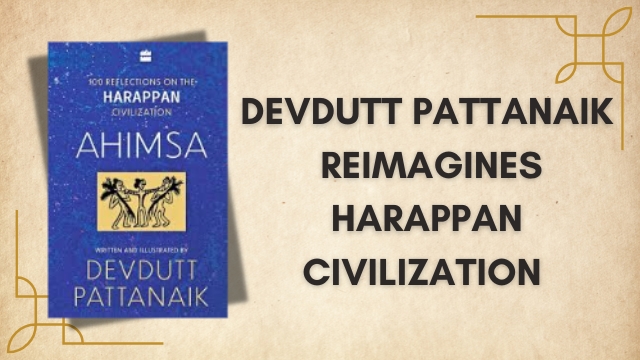
By In his latest book, Ahimsa: 100 Reflections on the Harappan Civilization, celebrated mythologist and author Devdutt Pattanaik invites readers on a reflective journey into one of the world’s earliest urban societies—the Harappan, or Indus Valley Civilization.
Rather than presenting a traditional historical account, Pattanaik offers 100 contemplative essays that explore the values, symbols, and spiritual rhythms of a culture that flourished over 4,000 years ago. Drawing on mythology, archaeology, and philosophy, he reimagines a society built not on conquest, but on balance, order, and non-violence—ahimsa.
Ahimsa and Harmony
In contrast to many ancient civilizations glorified for their wars and empires, the Harappans left behind no evidence of military ambition: no weapons, no kings, no tales of triumph. Instead, they offer a legacy of orderly cities, intricate seals, and objects that hint at a society anchored in cooperation, ritual, and commerce.
Pattanaik views this absence of violence not as an oversight but as a statement. He proposes that the Harappans embraced ahimsa not out of weakness, but as a civilizational choice. Their lives, he argues, revolved around a “merchant-monastic” ethos—a quiet harmony between material success and spiritual reflection.
“What if a civilization could thrive not through war, but through wisdom?” he asks. The question becomes a refrain throughout the book’s meditative pages.
Speaking Through Symbols
Pattanaik dives deep into the symbols of Harappa: the unicorn seals, the terracotta figurines, the animals etched into clay, the silent postures of female statues. To him, these aren’t just relics. They are visual texts—mythologies encoded in form.
The unicorn, often stamped on seals, becomes a metaphor for spiritual leadership and balance. The female figurines—typically reduced to fertility icons—are reinterpreted as symbols of grace, dignity, and divine femininity.
“The Harappans may not have written stories,” he reflects, “but they surely told them—in seal, in sculpture, in silence.”
Society Without Kings
Perhaps the most radical idea in Pattanaik’s book is this: Harappa thrived without centralized rule. There are no palaces, no throne rooms, no monuments to emperors. Instead, the city’s grid layout, sanitation systems, and egalitarian structures suggest decentralized, cooperative governance.
In a world where history is often told through the lens of kings and conquests, this absence is striking. Pattanaik turns this void into a provocation: How do you build a civilization without dominance? What stories must a society tell itself to sustain peace over power?
Echoes in the Present
One of Ahimsa’s quiet triumphs is how it connects ancient Harappa to contemporary Indian culture. Pattanaik finds echoes of Harappan thought in modern Hindu rituals, temple designs, and social customs. He argues that while Vedic and Aryan influences are well documented, Harappan contributions remain deeply embedded—just less acknowledged.
Harappa, in his view, is not a forgotten prelude. It is a spiritual and philosophical pinnacle in its own right—one that continues to shape India’s cultural DNA.
At the heart of Ahimsa is the idea that storytelling is what binds a society together. Myths, for Pattanaik, are not merely tales of gods or monsters; they are the unspoken agreements that define a people.
Though the Harappans left no written scriptures, their use of shared symbols—seals, figures, designs—suggests a culture held together by common narrative threads. These were stories not told through language, but through ritual, space, and rhythm.
“Their stories weren’t written in words,” Pattanaik writes, “but in the spaces between bricks, in the curves of a seal, in the grace of a figurine.”
Ahimsa does not claim to be definitive history. It is openly speculative, reflective, poetic. Pattanaik presents his work as a series of thoughtful possibilities, not academic conclusions.
Yet the impact of these reflections is profound. In an age still shaped by conflict and hierarchy, Ahimsa dares to imagine a civilization built on harmony and mutual respect. It repositions Harappa not as a puzzle of ruins to solve, but as a philosophy to rediscover.
In Ahimsa: 100 Reflections on the Harappan Civilization, Devdutt Pattanaik doesn’t just look back—he looks inward. His book is less a map of the past and more a mirror for the present, asking us to reexamine what makes a society truly great.
This is not a tale of dates and dynasties. It’s a journey through symbols and silence, a meditation on what it means to live wisely, peacefully, and with purpose.
And perhaps most importantly, Pattanaik reminds us that the most enduring myths are not those we invent, but those we inherit—quietly, symbolically, and eternally.